Disintegrating Sensation
Perceiving the truth in an age of digital simulacra and artificial intelligence

Read this on the Lyceum’s website [PDF available]
We have for the past few decades, largely unawares and too-little concerned until late, been living under conditions of a rapidly fragmenting sensibility. We relate what we see to what we hear (but smell, taste, and touch very little), and neither what is heard nor what is seen relates to something that is. In truth, the cracks of our sensory world first began with the earliest advent of electric technologies[1] (one might even say with the separation of modern physics from philosophical wisdom); but what began in the nineteenth century with a few spidery veins under the buzzing of electric light spread wide through radio and televisual communication, and what was deepened unseen with the computer, now is being realized in the opening, widening fissures of the networked digital age.
As Marshall McLuhan spent much of his career demonstrating, all communication technologies alter the ratios between not only themselves but also our cognitive faculties.[2] Put otherwise, we tend towards privileging different faculties of cognition depending upon the means by which objects are conveyed to us. In an oral culture—one where we transmit meaning primarily through the spoken word—we are more prevalently aural in our thinking, individually and communally. Conversely, where we privilege the written, we tend towards a more visual orientation of self and society alike. But it is not only our senses which have ratios. Rather, all our cognition—including things like memory or judgment—exist in such a proportion to one another. In the electric age, we find ourselves dealing with many more media of communication—increasing aimed at immersion—(for, arguably, all technologies are at least part of a communicative framework), which communicative innovations of the past two centuries have resulted in these ratios having been altered—nay, distorted—beyond all proportionality.
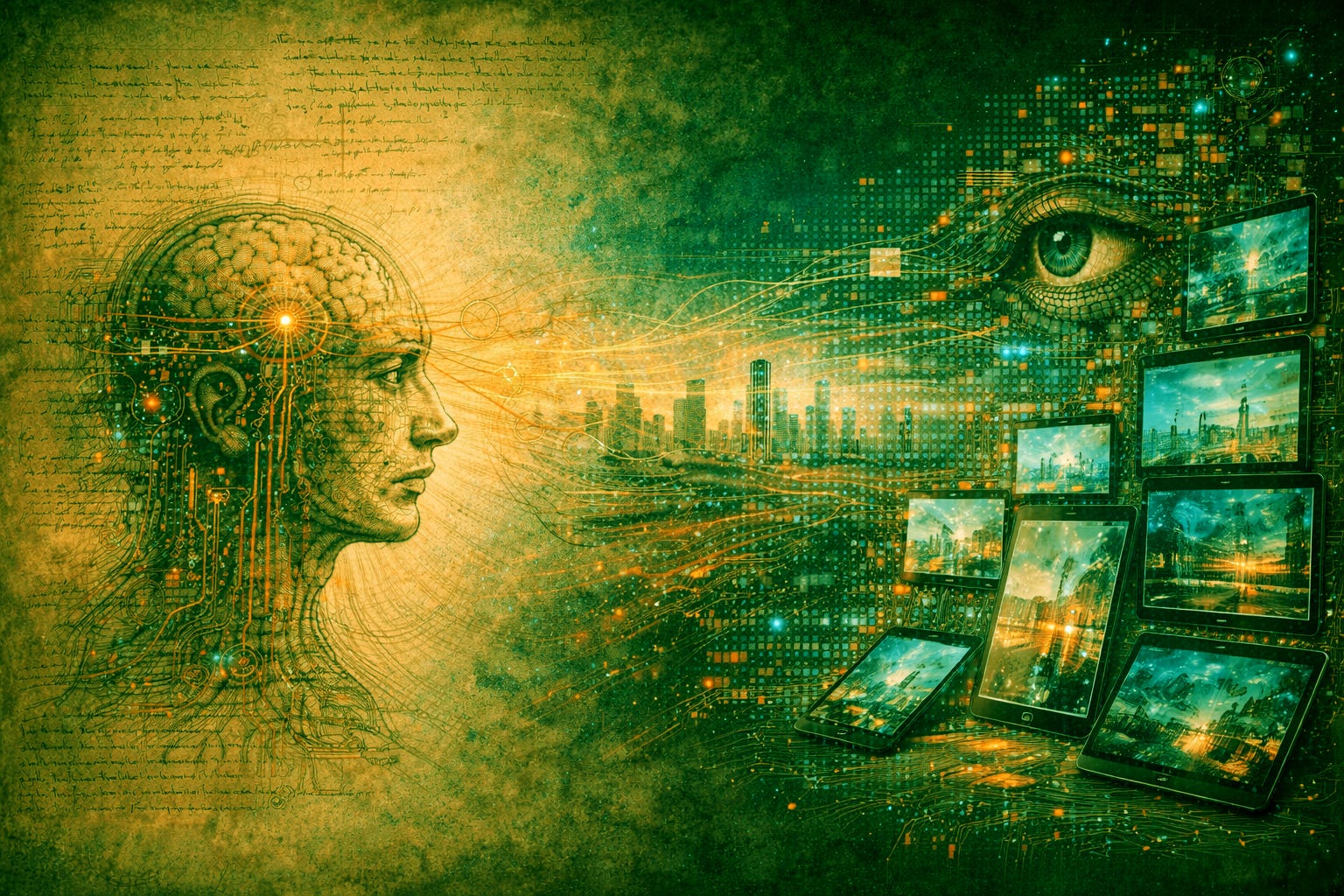
The technologies today being widely peddled (that is, marketed) as “artificial intelligence”—which, in truth, consist in nothing more than probability mechanisms presenting a simulacrum of human sentience—would be more aptly named “intelligence-simulators.” Despite their oft-overblown capacities, these technologies nevertheless threaten to completely shatter the proportionality of our cognitive faculties. The world always comes into the ambit of our cognitive awareness, from the lowest to the highest of our thinking processes, through external sensation: sight, hearing, smell, taste, and touch (which lattermost comprises a diverse array of sensorial modalities). Beyond or behind these external senses, there is that faculty which Thomas Aquinas—following the Aristotelian tradition—names the sensus communis. Rendering this Latin term by its English cognate of “common sense” requires extensive qualification that it not be misunderstood. Therefore, I propose to use the English name “integrating sense” for this power, because this integration seems, indeed, to be the objective of the faculty: to take the diverse sensory stimuli and render them into coherent objects upon which the elaborative cognitive faculties of both our interior senses—memory, estimation, imagination--and the intellect may operate. The result of this integration is to terminate the diverse sensorial array at a common point.[3] From this common point, our cognitive faculties—interior senses and intellect alike and together—elaborate the meaning of those phenomena that we have received. And it is precisely here, precisely at this point, that intelligence-simulators may cause a breakdown of our cognitive proportionality.
1. Integrating Sense
Thomas Aquinas discusses the sensus communis briefly in a number of texts: with interesting passages in the two Summae, the Quaestiones disputatae de veritate, Quodlibetal questions, the Sententia Metaphysicae and Sententia Ethicorum, and—of course and at quite some length and depth—in both the Sentenciae de Anima and de Sensu. It is in these latter two texts that one finds not only fascinating insights but interpretative difficulties, particularly as Aristotle’s own explanation of the power relies heavily upon an abstruse metaphor: namely, the relation of a geometric point to lines. Although my purpose in this essay does not include a defense of textual interpretation—though such a defense of course can be made—I do believe it necessary to exposit one point in particular.
We find Aquinas explains this relation of “point” to “line” as a metaphor for the integrating sense in both commentaries on the De anima and the De sensu. In the first, he claims that the relationship between the sensus communis and the particular senses can be understood in two ways: either as it is the one principle of all sensible immutation, or insofar as it is the principle and terminus of each individual sense.[4] The point, as Aristotle says, can be understood as indivisible in itself and yet relationally divisible, inasmuch as the same point is used as the terminus by two different relations: thus, the one and selfsame indivisible sensus communis is the terminus of both sight and hearing. Yet the faculty evidently remains something one because it not only senses the visible as visible and the audible as audible, and it not only judges the difference between the two, but it cognizes them simultaneously. Inasmuch as the two sensory receptions are terminated at the same point, they are united, or, we might say, integrated—not formally, but materially. Put in other words, different intelligible notions (the formal) coincide in the same subject (the material), as the notions of “loud” and “red” differ from one another, but both belong to the fire-engine with its sirens screaming. The sensus communis discriminates between the sensory phenomena (distinguishing between the “loud” which is heard and the “red” which is seen) simultaneously as it judges[5] that they belong together in the same subject, namely, the sensible (in this case, the fire-engine)—either as altogether present to a common sensory environment, or as this sensible, which twofold possibility Aquinas makes clear in his commentary on the De sensu et sensato.[6] For instance, I might sense something white and something sweet, not in strictly one and the same individual subjective entity, but placed together on the common subject of a single plate; or I might sense something that is both sweet and white, as the frosting of a cake. So long as they can be reduced to a common sensible rationale—that is to say, a rationale accordant with the sensorial objectivity—the diverse sensory objects can be held in a certain unity by the sensus communis.[7]
But, as a quick digression, this common-belonging to a sensible subject does not yet render that sensible into an object of properly cognitive awareness. The “judgment” of the sensus communis produces a stimulative object; not a terminative one. Put in other words, it constitutes a unified sensory but not a formally perceptual object. Because we experience objects as perceptual—that is, inasmuch as we have an awareness of them—we tend to conflate objects of sensation and perception. But sensation occurs through a physical or material immutation, while perception occurs only with an intentional immutation. Such an intentional immutation consists not solely in the reception of some stimulus but also the constitution of the object as a terminus of that awareness; in the language of later Scholasticism, the terminal object requires not only an impressed but also an expressed specification.
Our principal concern with the sensus communis, however, concerns its function of integrating the stimuli of diverse sensory modalities.[8] Without here getting too bogged down into the particulars, recent decades of neuroscientific inquiry have discovered that several regions of the brain seem to be involved in the integration of diverse sensory data. For instance, the superior colliculus seems to incorporate three layers that constitute differing maps of “visual”, “auditory”, and “somatosensory space”, and many of the neurons within these layers come to develop responses to multiple stimuli. For instance, one neuron within the superior colliculus will respond to both auditory and visual stimuli. When both kinds of stimuli are presented to a brain already familiar with their co-presence, the brain is more active in attending to the stimuli than if just either one of the two is present. We all likely have some experience of this phenomenon ourselves: if we hear someone in a crowded room without seeing him speaking—i.e., if we do not see his lips moving—we are far less likely to grasp what he says than if we both hear and see.
We can see the importance of multisensory integration through the negative example of autism. It has been hypothesized and given some substantial evidence from research that autism spectrum disorder (or ASD), may be caused or exacerbated at least in part by a neurological inability to integrate multisensory information. Among the many difficulties faced particularly by those with ASD are judgments concerning the simultaneity of different kinds of sensory stimuli,[9] cross-modal attention switching (i.e., changes in attention from auditory to visual),[10] and a focus upon details or aspects of an object presented to sensation without an ability to integrate those details into a coherent sensory whole.[11] While there are many complexities and individuated nuances across different cases in ASD, these difficulties, generally speaking, seem to revolve around an inability to affect an integration of diverse sensory modalities into unified stimulative objects. This inability impedes the operations of our higher cognitive faculties to correlate phantasmal or intellectual conceptions with diverse material objects. Thus we can observe that those with ASD sometimes exhibit profound and savant-like abilities to focus with great insight and talent upon specific formal aspects of objects, the material wholes of which elude their comprehension because the stimulative object they have formed presents an incomplete picture of the mind-independent subject.
While the conditions of autism demonstrate to us the most profound consequences of a fragmented sensibility for individuals—and as we will see momentarily, this is tied directly to the digital world we now inhabit—these conditions also help us to reflect upon our use of these technologies.
2. Broken Signs
Indeed, although engaging in Thomistic scholarship and explaining how contemporary neuroscientific research coheres with the Aristotelian-Thomistic conception of the integrating sense, are of course important tasks, our primary purpose in this essay consists in neither scholarly exposition nor defense of its relevance. Rather, we wish to see the danger posed to the integrating sense by the increasing ubiquity of intelligence-simulating digitally-mediated technologies—that is, those technologies masquerading under the deceptive moniker of “Artificial Intelligence”.
The digital age has rapidly accelerated the fragmentation of our sensory proportionality. Before we can explore this accelerated fragmentation, it must be noted that what we signify by the term “digital” is, in fact, a technology of technologies: it does not so much belong on the screens beneath our fingertips but rather runs through the veins our devices—or perhaps, even, what sparks the firing of our synapses. The 5G network of your smartphone, the Bluetooth connection to earbuds, the computer upon which I typed this essay, and the televisions located in homes, bars, gyms, hotels, and all throughout our screen-facing world—all are permeated by the digital, for each conveys its data through the digital information paradigm. Thus, each can—and increasingly we see this to be the case—be made to do the same things, to handle the same data, to output the same content despite the diversity of presentative media. The digital paradigm homogenizes the information which it receives. This homogenization allows for complex reconfigurations to be made with startling efficiency. Whereas the translation of the now supplanted VHF broadcast signal into anything other than that which is received by a VHF antenna requires many other steps and devices, we now can, with digital technology, translate a song into an image, or show a movie on your refrigerator—so long as it has a screen.[12]
What’s the point of drawing attention to this digital ubiquity? Simply put: we already inhabit a technological environment—and have for some time—in which we are faced continuously with sensory stimuli that resolve to no distinct underlying subjects possessed of their own natures. Consider the shifts in movie-making over the past century. While the creation of stages and sets has always been a part of the cinematic art—relatively few films having been shot entirely in real locations—today a great deal of what appears on the screen is not physically there at all. On a more basic level, even in television shows produced with a corporeally-present set, the visual perspective is given through rapid-switching of diverse camera angles; the yawn of real time is shortened through the montage or the quick-cut; and everywhere we find heightened dramatizations presented as though the norm. Similarly, since not long after films departed silence, most of the sounds in movies have been faked, such that what you are hearing is not what you are seeing—from the sounds of horse hooves to the rustling of leaves or the scratching of a face, most of what we have heard in movies has been the product of what is known as Foley art. Today, vast libraries of already-recorded and synthesized sounds and ability to manipulate them digitally makes the sound even less “real”. Decreasingly have the products of our art come from an immediate effect of technical know-how in the artist and increasingly from the capacities of a system. There remains, of course, an art in manipulating that system—but it seems the work produced becomes farther and farther removed from the artist, even as the ability to present accurate and convincing simulacra of the represented phenomena increases.
The occasional suspension of reality in favor of fictionalized presentations, and with a strong awareness that we are observing something unreal (or better yet, that something deeply real abides in the unreal presentation), may do relatively little harm to our psychological formation (and even some genuine benefit). But what happens when real and unreal become indistinguishably blurred in our perceptual environments? What happens when our neurological avenues for integrating diverse sensory phenomena are bombarded endlessly by objects without any underlying common subject? We live already in a world where the lines of reality have been blurred and our brains have (been) adapted to the lack of distinction between the real and the unreal. Our eyes and ears are filled with objects of no mind-independent sustenance. In the words of Anton Barba-Kay, “Online browsing tempts us to a twilit, oneiric realm in which our fantasies take on manifest forms outside our minds.”[13] With the bend of digital technology ever-more-towards the realization of these manifest forms, we create fantastic, unreal, deceptive images of what we wish to see right alongside things that are, that can be in fact, with no readily-discernible distinction between the two. The consequences of this have been, frankly, devastating.
Though far from definitive, quite a lot of research—as well as the primary observations we have all likely made with our own eyes and ears—has linked the increasing apparent prevalence of ASD, not only in its most explicit but even its highest-functioning forms, with the digital permeation of our environments and especially the frequent use of screens early in life.[14] The precise mechanism by which these devices impact the neurological development of young brains is far from fully distinguished. The hypothesis that it occurs by presentation of only fragmented sensory objects, however unproven, makes a great deal of sense, given the symptoms exhibited. Certainly, in young children and adolescents, it has been shown that high-exposure, low interaction, interruption-heavy (i.e., frequent attention-grabbing), and background contexts of screen usage and presence result in poorer language, executive, and general cognitive performance.[15]
But we ought to ask also, I believe, what effects these kinds of digitally-permeated environments have on more typically-developed brains—effects more difficult to see, perhaps, because we have all been suffering them. Indeed: our fragmented sensation affects not only neurological development but our persistent interaction with the environment. The highest acts of intellectual understanding yet require connection to the perceptual that they be complete. Though our perceptual cognition itself is elaborated through the internal senses of the imagination, memory, and cogitative faculty, these perceptual cognitions do not exist in a catalog of unmoved persistence, but continue to be shaped and re-shaped dynamically through our continued sensorial experience. If the stimulative objects of our sensation are not themselves experienced as integrated realities, as things independent of the mind with their own proper subjectivities, then “meaning” will appear to come primarily if not solely from our own minds, and not from things themselves, or with any necessary resolution to them. We lose things themselves as the objects of our inquiry; we receive only disjointed representational fragments.
Our cognitive operations, in consequence, manifestly suffer: not only in the increasing prevalence of ASD and other such diagnosable disorders, but in the general prevalence of unreasoned and unreasonable beliefs dominating the public sphere.
But we are now on the precipice of a much steeper cognitive decline.
The primary function of LLM intelligence-simulators consists in analyzing and reconfiguring patterns of digital data. They are able to do this far more efficiently than any human being—and thus to synthesize in reconfiguration according to algorithmically discerned patterns emergent from a quantity of points incalculable by a human mind. If I ask you to reflect upon all the images of horses that you have seen, and all the direct experiences of horses that you have had, and to draw me a realistic image of them, it will likely take you some time. If I give the same prompt to ChatGPT, it will give me a very sophisticated image in about 30 seconds. Similarly, if I ask you to summarize the Warsaw Pact, you might pause to remember what it was, when it happened; you might need to look up details. I asked ChatGPT and received all the major details before I could finish typing this sentence. I can also ask it—and receive just as quickly—to represent the Warsaw Pact in a triptych according to the style of Hieronymus Bosch. In the former two cases, that of the horse and of the description of the Warsaw Pact, we see extraction from human presentations (drawings, photographs, and verbal accounts), homogenized and synthesized into a presentation which is novel in its particularity but commonly resoluble to something of real experience. However, there is no functional difference whatsoever in ChatGPT’s creation of an image of a horse and that of the triptych. In 2023, Netflix began streaming a Reality TV show titled Deep Fake Love, in which contestants watched a video of their significant others cheating on them in convincing faked videos—to the psychological torture of those watching.[16] Already, OpenAI has introduced a video-production model, named “Sora”, which (in only its first semi-public iteration) can produce high-quality realistic minute-long videos from nothing more than a textual prompt.[17] What were unthinkable productions a few decades ago now may take remarkably little effort. Improvements to this technology will, of course, revolutionize the industries of cinema, television, gaming, virtual and augmented “realities”. If ever they become integrated with direct neural interface devices—such as those being developed by Neuralink, Neurode, or Synchon—such that not only can brains directly interface with instruments, but that sensations may be simulated, we may find our sensorial integration with the mind-independent world not only to be fragmented but divided by an ever-growing chasm.
But even without such direct neurological interference, unleash the ability for convincing and rapid audio-visual fabrication through every device now permeated with digital technology and we will quickly inhabit a world of perceptual phenomena irresoluble to a sensible mind-independent real; layers upon layers of patterns derived from human input reconfigured in a manner entirely inhuman, building a world utterly devoid of objects in which we can trust. Moreover, it seems likely we will find our memories entirely undermined by this lack of resolution—incapable not only of holding to the consistency of a stable mind-independent reality but even of holding ourselves in any coalescent sense of coherent selfhood.[18] We have been trending in this direction of sensory disintegration for decades—but intelligence-simulating digital technology will accelerate us along this trajectory a thousandfold. As devices increasingly mediate our interactions, we will find ourselves correspondingly inundated with increased indistinction between entia rationis (beings of reason) and entia naturae (beings of nature). The networked digital paradigm and its permeation by LLM intelligence simulating technology may not distort your own cognitive faculties, in your own lifetime—but the next several generations will suffer for it greatly, absent a radical shift in thinking not only about technology, but, more fundamentally, about our humanity.
3. The Recovery of Proportion
The danger posed by contemporary digital and intelligence-simulating technologies does not consist principally in the production of false propositions, nor even in the displacement of human labor by automated systems. More fundamentally, it consists in the gradual erosion of the conditions under which truth can appear to us at all. Truth is not the product of intellectual systemization but a discovery and conformity affected through rigorous inquiry about what is. That conformity presupposes not only intellectual activity but a properly ordered sensory foundation upon which higher cognition relies. Where that foundation becomes unstable, truth itself becomes imperiled. Thus, our technologies do—in fact—pose a real danger to our humanity; but principally because we have immersed ourselves in an environment hostile to the activities that allow our humanity to flourish.
The integrating sense occupies a decisive place in the environment of flourishing. It is the faculty by which diverse sensory stimuli are united into coherent sensibles, providing the material unity required for perception, imagination, memory, and ultimately for both intellectual discovery and subsequent understanding. Where sensation fails to integrate—where what is seen, heard, and otherwise experienced does not resolve to a common object—cognition is deprived of its proper object. What remains are fragments: images without things, sounds without sources, representations without realities. In such a condition, meaning no longer appears as something received from beings but as something imposed upon disordered data. Digitally mediated environments increasingly confront us with precisely this condition. The homogenization of all information into a manipulable digital substrate allows for the indefinite recombination of sensory presentations without reference to any mind-independent unity. Images, sounds, and narratives are generated, altered, and disseminated without originating in—or resolving back to—sensible subjects. Intelligence-simulating systems accelerate this process by producing outputs that make these generated objects appear seamlessly with those that are real. The result, however, is not merely confusion between the real and the unreal, but the gradual habituation of the mind to objects that cannot be integrated—because there is no object within which integration could occur; just a flurry of ephemeral disjointed sensory phenomena.
The consequences of this disjointed sensory environment extend beyond perception and into intellectual thought itself. Intellectual acts remain dependent upon phantasms, and phantasms upon sensation. Where sensation is persistently fragmented, the intellect increasingly operates upon either internally generated patterns (cognitive fictions) or upon simulated coherences (on screens or through other devices) rather than upon beings. Truth thus comes to appear as coherence within one’s accepted systems rather than as an adequation to the mind-independent intelligible real. This shift manifests as a tacit orientation of thought away from discovery and toward construction.
The recovery of proportion, therefore, cannot consist merely in better content, improved regulation, or more responsible technological design—though each may have its place. It requires, more fundamentally, the restoration of those conditions under which sensible unity is possible and under which language, judgment, and understanding again resolve toward what is. This restoration is not primarily technological but educational, in the sense of truly educating the human soul. It consist in renewing and revitalizing the communally-fostered habits by which human beings remain attuned to a shared, mind-independent world: habits of attention, discrimination, and most of all of linguistically-robust understanding grounded in common experience.
Linguistic signification, though it reaches its first initial perfection within the one speaking, is not fulfilled in isolated interiority nor in relaying commands to impersonal systems, but in the abundant overflow of communicative acts ordered toward the truth of something perceived and shared in common. Where the sensible world fragments, language loses its anchorage; where language loses its anchorage, truth becomes elusive. To preserve the possibility of knowing, therefore, is to preserve the integrity of sensation as ordered toward being—but also to preserve language’s connection to the things that themselves are, and as intelligible objects relayed through linguistic disclosure.
That is, language occupies a privileged place in any attempt at cultural restoration precisely because it alone possesses the capacity to gather, order, and render intelligible not only the full range of human experience but the constituent realities whereby that existence is possible in the first place. While sensation provides the material conditions for cognition, language gives form to what is known by making it sharable, stable, and revisable across time and persons. Linguistic signs do not merely label pre-existing thoughts; rather, they complete the act of understanding by articulating it. As such, language functions as a secondary but indispensable mode of integration: where the integrating sense unifies sensible data into perceptual objects, language unifies those objects within a common intelligible world—rendering the world more than merely sensed; rendering it understood. A culture that loses confidence in language’s power to signify reality will inevitably lose confidence in reality’s intelligibility itself.
This integrative power of language depends upon its grounding in a shared, mind-independent world. Linguistic signification is neither a private projection nor a self-contained system of symbols; it is ordered toward making known what is. Grammar, syntax, and semantic distinctions are therefore not arbitrary conventions but reflections—however imperfect—of the structure of being and the relations that obtain within it. When language is treated merely as a manipulable instrument for effect, persuasion, or efficiency, it becomes detached from this grounding and collapses into pragmatics alone. Such detachment mirrors, at the level of thought, the fragmentation already introduced at the level of sensation by digitally mediated environments. Restoring linguistic discipline—through careful attention to meaning, relation, and form—is thus not pedantry but an act of cultural repair, for it will allow us to see through the sensory obfuscations and fragmentations, to perceive what must be the case, even when appearances deceive.
Finally, language restores culture not primarily by transmitting information, but by sustaining the conditions for inquiry. Genuine linguistic exchange presupposes that speaker and listener are jointly oriented toward something held in common, something that can be questioned, clarified, and known more deeply. In this sense, language is intrinsically dialogical and irreducibly interpersonal: it unfolds most fully not in isolated consumption of content, but in acts of speaking to and with others about the world we share. Where such acts persist, even within technologically saturated environments, they preserve a space in which truth may again be encountered rather than constructed. The recovery of proportion in our cognitive life therefore passes necessarily through the recovery of language as a disciplined, reality-oriented, and communal art.
We must again learn to speak to one another if we are to affect a more properly integrative world, a world fit for human beings.
[1] 1964: Understanding media, 29: “Submerging natives with floods of concepts for which nothing has prepared them is the normal action of all our technology. But with electric media Western man himself experiences exactly the same inundation as the remote native. We are not more prepared to encounter radio and TV in our literate milieu than the native of Ghana is able to cope with the literacy that takes him out of his collective tribal world and beaches him in individual isolation. We are as numb in our new electric world as the native involved in our literate and mechanical culture.”
[2] Cf. for example 1964: Understanding Media, 78: “What I am saying is that media as extensions of our senses institute new ratios, not only among our private senses, but among themselves, when they interact among themselves.”
[3] This denomination is hardly novel; cf. Schmidt 1983: “The Unifying Sense: Which?” in The New Scholasticism 57.1: 1–21. Schmidt argues against the main commentators of the 20th century that the vis cogitativa is principally responsible for the unification of sense. I agree with Schmidt on a specific and important point: namely, that the formal objects of our awareness are constituted through operations of the vis cogitativa, by which alone does the sensible-something attain the level of perceptual-evaluation (and thus become an object of our awareness rather than merely of our senses). However, I disagree inasmuch as I hold that the material object of our awareness must necessarily be assembled into a kind of sensorial unity before it can receive this formal constitution, to which function the sensus communis is appointed.
[4] 1268: Sentencia De anima, lib.2/lib.3, lec.27/lec.3, n.609-631/n.11-15. Note that significant differences occur between the Leonine and Marietti editions of these texts, not only as to orthography, punctuation, and specific words, but also as to numbering of libri et lectiones.
[5] 1266-68: ST Ia, q.78, a.4, ad.2: “Unde oportet ad sensum communem pertinere discretionis iudicium, ad quem referantur, sicut ad communem terminum, omnes apprehensiones sensuum; a quo etiam percipiantur intentiones sensuum, sicut cum aliquis videt se videre. Hoc enim non potest fieri per sensum proprium, qui non cognoscit nisi formam sensibilis a quo immutatur; in qua immutatione perficitur visio, et ex qua immutatione sequitur alia immutatio in sensu communi, qui visionem percipit.” I believe this judgment (discretionis iudicium) should not be understood in a strict sense—Aquinas does, after all, use the term in a myriad of ways (cf. Poinsot: 1631: Ars Logica Prima Pars, q.d.5; R.I.144a25–150b18)—but rather in a metaphorically-said manner, inasmuch as judgment is the intellectual operation by which we both compose and divide formal unities or disunities.
[6] 1268: Sentencia De sensu et sensato, tr.1, c.18/1.7, n.286-289, especially the lattermost. Cf. 1265/66: SCG lib.2, c.100, n.3: “unde videmus quod diversa genera sensibilium, quae quinque sensus exteriores percipiunt, una vis sensus communis apprehendit.” 1266-68: ST Ia, q.1, a.3, ad.2: “obiectum sensus communis est sensibile, quod comprehendit sub se visibile et audibile, unde sensus communis, cum sit una potentia, extendit se ad omnia obiecta quinque sensuum.” i.1256-59: Quodlibet VII, q.1, a.2, ad.1: “dicendum est de potentia sensitiva, quod non potest simul plura primo sentire, sed ex consequenti, in quantum plura accipiuntur ut unum, sicut sensibilia differentia uniuntur in una differentia, et plura sensibilia quae sunt partes uniuntur in uno toto, unde quando sentitur totum, sentiuntur simul plures partes ex consequenti, et tunc intentio sensus non fertur ad aliquam partium principaliter, sed ad totum, quia, si ad aliquam partium ferretur ut ad sensibile principale, non simul sentiretur alia. Et iterum sensus communis, quamvis sit una potentia secundum essentiam, tamen aliquo modo multiplicatur secundum esse in quantum coniungitur diversis sensibus propriis, sicut unum centrum coniungitur pluribus lineis; unde immutationes omnium sensuum simul terminantur ad sensum communem, sicut motus qui esset per omnes lineas posset simul terminari ad centrum.”
[7] i.1256-59: DV, q.15, a.1, ad.3: “quod sensus communis, cum omnia sensibilia percipiat, secundum philosophum, oportet quod in ea feratur secundum unam communem rationem, alias non haberet unum per se obiectum; sed in hanc communem obiecti rationem nullus sensuum propriorum pertingere potest. Sed in simplicem acceptionem ratio pertingit sicut ad suum terminum, ut quando discursus rationis in scientia concluditur. Unde non oportet quod in nobis intellectus sit alia potentia a ratione, sicut sensus communis a propriis.” Ibid, a.2, c.: “Sed cum in natura corporea inveniatur aliquid in quo omnia corpora conveniunt, aliquid vero in quo diversa corpora diversificantur; possibile erit aptari unam potentiam corpori alligatam omnibus corporibus secundum id quod commune habent; sicut imaginatio prout omnia corpora communicant in ratione quantitatis et figurae et consequentium (unde non solum ad naturalia, sed ad mathematica se extendit); sensus vero communis prout in omnibus corporibus naturalibus, ad quae solummodo se extendit, invenitur vis activa sive immutativa.”
[8] Ibid, q.57, a.2, c.: “Hoc enim rerum ordo habet, quod quanti aliquid est superius, tanto habeat virtutem magis unitam et ad plura se extendentem, sicut in ipso homine patet quod sensus communis, qui est superior quam sensus proprius, licet sit unica potentia, omnia cognoscit quae quinque sensibus exterioribus cognoscuntur, et quaedam alia qua nullus sensus exterior cognoscit, scilicet differentiam albi et dulcis.”
[9] Stevenson et al. 2014: “Multisensory Temporal Integration in Autism Spectrum Disorders” Journal of Neuroscience, 34.3: 691–697 [DOI:10.1523/JNEUROSCI.3615-13.2014]. Foss-Feig et al. 2010: “An extended multisensory temporal binding window in autism spectrum disorders”, Experimental Brain Research, 203.2: 381–389 [DOI: 10.1007/s00221-010-2240-4].
[10] Brandwein et al. 2015: “Neurophysiological Indices of Atypical Auditory Processing and Multisensory Integration are Associated with Symptom Severity in Autism”, Journal of Autism and Developmental Disorders, 45.1: 230–244 [DOI:10.1007/s10803-014-2212-9].
[11] Happé and Frith 2006: “The Weak Coherence Account: Detail-focused Cognitive Style in Autism Spectrum Disorders”, Journal of Autism and Developmental Disorders 36.1: 5–25 [DOI:10.1007/s10803-005-0039-0]. Booth and Happé 2016: “Evidence of Reduced Global Processing in Autism Spectrum Disorder”, Journal of Autism and Developmental Disorders [online – DOI:10.1007/s10803-016-2724-6]. It is worth noting that the superior colliculus not only receives but also shapes attention direction; malformation of neurons in the superior colliculus may not only result, that is, in an inattentiveness, but exacerbate it. Cf. Krauzlis 2014: “Attentional Functions of the Superior Colliculus” in Nobre and Kastner (eds.), The Oxford Handbook of Attention, online edition [DOI: 10.1093/oxfordhb/9780199675111.013.014].
[12] Through the homogenization of the data stored in a digital paradigm, we can easily transduce the patterns of one medium into another. Because of the ability, further, to compress this data, we can store enormous quantities of it with minimal loss. More poignantly, so long as we have an apparatus which can translate a sensory medium into a digital data, we can produce representations of any sensory phenomenon. While odor and tactile digitization technologies—both those which translate the sensory phenomena into digital data and those that, from such data, reproduce simulacra of such experience—such technologies remain nascent, but their development is well under way.
[13] 2023: A Web of Our Own Making, 124.
[14] Heffler et al. 2020: “Association of Early-Life Social and Digital Media Experiences With Development of Autism Spectrum Disorder-Like Symptoms” in JAMA Pediatrics, 174.7: 690–696 [DOI: 10.1001/jamapediatrics.2020.0230]. Zhao et al. 2022: “Association Between Screen Time Trajectory and Early Childhood Development in Children in China” in JAMA Pediatrics, 176.8: 768-775 [DOI: 10.1001/jamapediatrics.2022.1630]. Kushima et al. 2022: “Association Between Screen Time Exposure in Children at 1 Year of Age and Autism Spectrum Disorder at 3 Years of Age: The Japan Environment and Children’s Study” in JAMA Pediatrics, 176.4: 384-391 [DOI: 10.1001/jamapediatrics.2021.5778]. Sarfraz et al. 2023: “Early Screen-Time Exposure and Its Association With Risk of Developing Autism Spectrum Disorder: A Systematic Review” in Cureus [DOI: 10.7759/cureus.42292].
[15] Christodoulou and Roussos 2025: “‘Phone in the Room, Mind on the Roam’: Investigating the Impact of Mobile Phone Presence on Distraction” in European Journal of Investigation in Health, Psychology, and Education, 8.15.5.74 [DOI: 10.3390/ejihpe15050074]; Mallawaarachchi et al. 2024: “Early Childhood Screen Use Contexts and Cognitive and Psychosocial Outcomes: A Systematic Review and Meta-analysis” in JAMA Pediatrics 178.10: 1017-26 [DOI: 10.1001/jamapediatrics.2024.2620]; Bal et al. 2024: “Examining the relationship between language development, executive function, and screen time: A systematic review” in PLoS One 26.19(12) [DOI: 10.1371/journal.pone.0314540]; Miller et al. 2023: “Impact of digital screen media activity on functional brain organization in late childhood: Evidence from the ABCD study” in Cortex 169: 290-308 [DOI: 10.1016/j.cortex.2023.09.009]; Siebers et al. 2023: “The effects of fragmented and sticky smartphone use on distraction and task delay” in Mobile Media & Communication, 12.1 [DOI: 10.1177/20501579231193] Hutton et al. 2022: “Associations between digital media use and brain surface structural measures in preschool-aged children” in Scientific Reports 12.19095 [DOI: 10.1038/s41598-022-20922-0].
[16] https://www.euronews.com/culture/2023/07/25/the-cruellest-show-on-tv-deep-fake-love-goes-too-far-with-ai.
[17] https://openai.com/sora.
[18] Multisensory integration creates better memory performance—see Okray et al 2023: “Multisensory learning binds neurons into a cross-modal memory engram” in Nature 617 [DOI: 10.1038/s41586-023-06013-8], 777-84.